Monday, May 9, 2011

GREENBERG GETS REPACKAGED

For the first time in a long time, a Spider-Man book published by Marvel Comics with my name on it will be out in stores this week. It's a trade paperback that includes material I wrote during my last year at the company that has never been repackaged before.


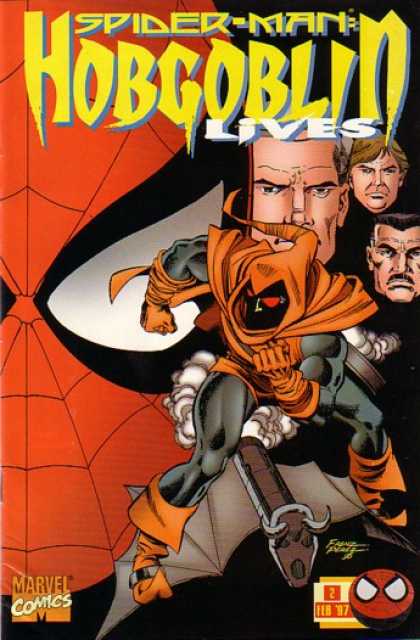
This book, Spider-Man: Hobgoblin Lives, actually includes two major storylines that I worked on, both of which focus on the super-villain known as the Hobgoblin. I initiated and served as the hands-on editor of the first story, Hobgoblin Lives, which was written by Roger Stern—one of the best Spider-Man writers of all time—and illustrated by the equally awesome Ron Frenz (with inks by George PĂ©rez, Scott Hanna, Jerome Moore, and Bob McLeod). Originally published as a three-issue limited series, this story, which finally revealed the true identity of the Hobgoblin as Roger originally conceived it, was collected as a trade paperback once before, but has long been out of print.


The new edition of the book includes a second storyline, which I conceived and co-wrote. "Goblins at the Gate"—a direct sequel to Hobgoblin Lives—was published in The Spectacular Spider-Man #'s 259-261. It's the last Spider-Man story I worked on, and it's one that I'm still proud of.

I first learned of this new edition a few months back, when Roger Stern e-mailed me to tell me about it. Naturally, I was very pleased. I contacted the appropriate editor at Marvel and let him know that, if the company was interested, I'd be happy to write an introduction or a foreword or an afterword or some other kind of text piece for the book, with Roger hopefully contributing a new piece of his own. I received a very polite, "We'll get back to you" response. I never heard back. I guess the company just wasn't interested.

But it hit me today: this is the Internet Age. I have a blog. I can go ahead and write the piece and put it online, just in time to coincide with the book hitting the comic-book stores on Wednesday, May 11.

So that's what I've done. If you buy the book—and I hope you will, as I think both stories are really good reads and it's great that they're now together in one volume—think of the piece below as bonus content, at no extra cost.


MY HISTORY WITH THE HOBGOBLIN
By Glenn Greenberg

It was the Hobgoblin that made me a devoted Spider-Man fan. I remember that it was December 1982, and I hadn't been reading any Spider-Man comics for a while. As a pre-teen, I'd read most of the classic Stan Lee/Steve Ditko stories in reprint publications, and I'd read scattered issues of the various Spider-Man titles over the years. But by late 1982, at the age of 13, I was focused on Batman, Detective Comics, The Incredible Hulk, The Savage Sword of Conan, and Marvel's Star Wars series. Spider-Man just wasn't on my radar anymore.

But a friend of mine, Anthony Bongiorno, a fellow comic-book enthusiast, asked me if I'd read the most recent issues of the two main Spider-Man titles, The Amazing Spider-Man and Peter Parker, The Spectacular Spider-Man. When I told him no, he responded, "Well, you should. The new editor, Tom DeFalco, has done a great job reinvigorating those books. The latest issue of Amazing introduces a new villain who's going to really shake things up in the months to come."

I just kind of nodded and shrugged, not particularly interested. But the next time I saw Anthony, a few days later, he gave me a copy of the issue: The Amazing Spider-Man #238, written by Roger Stern and illustrated by John Romita Jr. and John Romita Sr. It was for me to keep. (Anthony was a very generous guy!)


Anthony insisted that I read it. I did. And from that moment on, I was hooked. I started buying both Amazing and Peter Parker on a regular basis. Anthony was right—under editor Tom DeFalco, the Spider-Man books were great reads. And this new villain, the Hobgoblin, was exactly the right hook to pull me in, seeing as how he was following in the footsteps of the Green Goblin, who had always been my favorite Spider-Man foe.

The Hobgoblin's true identity remained a mystery, though Roger Stern dropped hints and clues along the way. The mystery was building, the clues were piling up, it was all going somewhere... and then Roger left Amazing with #252, with the Hobgoblin's true identity remaining unknown. What a bummer! But Tom DeFalco took over as writer and kept the story going quite capably. In fact, Tom and his frequent collaborator, artist Ron Frenz, are responsible for some of the most memorable Hobgoblin stories of all time.

But by the time the Hobgoblin's identity was finally revealed in Amazing #289, Tom and Ron had been removed from the title and the storyline had been disrupted and knocked off course, due primarily to editorial interference and office politics. Peter David ended up writing the revelation issue and did the best job that could be done under the circumstances. But to many readers—myself included—the big reveal was a big letdown.


Fast-forward to circa 1994. At that point, I had been working at Marvel as an assistant editor for about two years. I read an interview with Roger Stern, in which he said that the Hobgoblin revelation story was nothing like what he had in mind for the character. News to me! Noting that most fans seemed to be dissatisfied with that story, Roger went on to describe how the details in Peter David's story essentially proved that the guy who was revealed to be the Hobgoblin simply couldn't have been the real guy. Roger stated that his original idea could still be done, if the folks at Marvel were interested, and he had already offered more than once to come back and do it. But no one had ever taken him up on it.

Fast-forward again to 1996. I was now working in the Spider-Man Group and we were looking for new projects to do. By that point, I had spoken to Roger on numerous occasions, in my attempts to get him back on Spider-Man in some capacity, but he and I just hadn't found the right project for him. But then I remembered that interview. I called Roger again to see if he was still interested in doing that Hobgoblin story. He was. I scrambled around the offices to try to get all the necessary folks at Marvel interested in doing it. They were—but with one condition. They needed to know beforehand who Roger was intending to reveal as the Hobgoblin. (He had actually managed to keep it a secret all those years.) I told all this to Roger. Trusting me to keep a lid on it, Roger explained the scenario to me. I then explained it to my bosses behind closed doors. They were satisfied enough to sign off on it.

The end result: Spider-Man: Hobgoblin Lives, on which I served officially as assistant editor under editor Tom Brevoort—but Tom allowed me to act as the hands-on editor for this project and to work directly with Roger, artist Ron Frenz, and the rest of the creative team. I remain grateful to Tom for that. It was such a fun project to work on. I remember preparing for it by reading every single Hobgoblin story published up to that point, and comparing notes with Roger and discussing how to address various continuity conundrums and inconsistencies that crept in over the years. Of course, Roger did a masterful job taking all of that into account, using it to his advantage, and making everything seem like it was intentionally planned out that way from the start. I remember Ron Frenz's initial—and completely understandable—hesitation when I offered him the gig, as he wondered if too much time had passed to do this story and whether Roger could really pull it off. Nevertheless, Ron decided to take a chance and agreed to come aboard—and when he read Roger's plot for the first issue, his skepticism immediately turned to enthusiasm. The finished product is something I think everyone involved is still very proud of.



Fast-forward one more time, to early 1998. I was now an associate editor with my own titles to edit, and doing more and more writing work for the company. Ralph Macchio (the other one, not the Karate Kid) was the editor of the Spider-Man titles, and he found himself without a regular writer for the Spectacular Spider-Man series. Launched in 1976 as Peter Parker, The Spectacular Spider-Man, this long-running title was winding down to make way for a major Spider-Man relaunch at the end of the year. But Ralph still needed someone to write the last batch of issues.

I had just recently helped Ralph out on a couple of issues of Spectacular, contributing a plot and two scripts. I guess he liked what I had done, because he strolled into my office one day and said, "Glenn, I need someone to take over Spectacular. Do you think you can come up with a three-parter to get me through the next three months, something big and attention-getting, that I can really play up in the marketing materials?" I paused for a second, thought about it, and then I looked up at Ralph and said, "Yes—but before I talk to you about it, I need to make a phone call. I'll get back to you in a little while."

And then I called Roger Stern. During the time we were working together on Hobgoblin Lives, Roger had mentioned to me that the next thing he would love to do with Spider-Man was a story that had never been done before, that could never have been done before: the original Hobgoblin vs. the original Green Goblin. But now it was possible. The original Hobgoblin, his identity now revealed, was back in play and could be picked up on easily. And the original Green Goblin, Norman Osborn, had recently returned to the Spider-Man titles after a nearly 25-year absence. The two characters had never met. There would naturally be plenty of sparks between them. I loved the idea, but there didn't seem to be any venue for it at the time. But now Ralph had just dropped this opportunity in my lap.

The thought that immediately popped into my head when Ralph came to me was "Original Hobgoblin vs. Original Green Goblin." But just as immediately, I put the brakes on. This was Roger's pet idea. I was in a position to do it, but I couldn't, not without discussing it with Roger first. My goal in making that call to him was to get his involvement, or at the very least, his blessing. If I got neither, I would not go ahead with it. I would have then concentrated on coming up with another story idea.

I remember that by the time I finished dialing Roger's number, I had already come up with the starting point of the story—the "inciting incident," if you will. But I had to stop myself from thinking it through any further—after all, this was a story I might have to just forget about. I got Roger on the phone, explained my situation to him, and invited him to join me in whatever capacity he wanted or had time for. He was totally agreeable to coming aboard. I mentioned to Roger the inciting incident I had come up with. He loved it and knew exactly where to go with it. We were perfectly in sync. I then went back to Ralph, pitched him the basic concept—and the participation of Roger Stern—and got an immediate thumbs-up.

Roger and I worked out a scenario in which we would hash out the plot for each issue over the phone, I would write up a full plot based on our conversation, then e-mail it to him, and then he'd provide notes, revisions, suggestions, etc. The revised plot would go off to the artist, Luke Ross, and once the art came in, I would write the full script and e-mail it to Roger for his input. The process was smooth as silk, and I have to mention that Luke did a wonderful job on the pencils. Since then, he's only gotten better, having developed into one of the best comic-book artists around today. I'd love the opportunity to work with him again.

Our story, "Goblins at the Gate," ran in The Spectacular Spider-Man #'s 259-261, with beautiful covers illustrated by legendary Spider-Man artist John Romita Sr. I came up with the title for the story—it was a play on Barbarians at the Gate, a then-recent HBO TV movie about corporate intrigue. Seemed appropriate, given the tale we were telling, and I remember that Ralph Macchio got a kick out of it.


Roger Stern couldn't believe that I gave him top billing in the credits. He felt I did all the heavy lifting and that he was just along for the ride. But as far as I was concerned, it was a no-brainer. It was a privilege and an honor for me to be sharing a writing credit with him. The story would not have existed without him—he gave it his blessing and agreed to work on it with me. He made very important contributions to each plot—I learned a lot from working with him. And from a purely commercial standpoint, I knew that Roger Stern's name on a Spider-Man book meant a lot more than mine. I'm still fine with how the credits read.

For me, the one tiny blemish on the project is that our ending isn't what we originally envisioned. Roger and I were going to unmask and reveal the identity of the mysterious new Green Goblin working for Norman Osborn. I thought what we had planned would be a nifty, surprising reveal, and that it would have worked very well, particularly given the Spider-Man continuity of that time. But somewhat late in the process, we were asked not to go that route, to leave the new Goblin's identity a mystery for Spider-Man's regular ongoing writer to tackle in a future story. Roger and I complied—we still unmasked the new Goblin, but his identity remained unrevealed. It was disappointing to lose what would have been one of our Really Big Moments, but in the grand scheme of things, the change didn't really hurt the story, so it wasn't something that ever really kept me up at night gnashing my teeth.

When I look back on "Goblins at the Gate," I remember a very satisfying experience. I got to write a major storyline for one of the biggest, most iconic comic-book properties in the world, I collaborated on it with one of my writing idols, I wrote it for one of the most experienced and nurturing editors in the business, it was masterfully illustrated by a very talented artist, and all three covers were illustrated by John Romita Sr. What more could any comic-book writer ask for?

By the way, on the slim chance that Anthony Bongiorno is reading this—I still have that copy of The Amazing Spider-Man #238 that you gave me, Anthony. Thanks again.

Wednesday, May 4, 2011

EARLY REVIEW: THOR


Marvel's winning streak at the box office is likely to continue with the release of its latest super hero blockbuster, Thor. Directed by Kenneth Branagh, who always seems to hit a home run when tackling Shakespeare (I enjoyed his takes on Hamlet and Much Ado About Nothing) but who can stumble badly when he takes on more "commercial" fare (his Mary Shelley's Frankenstein is an infamous misfire), Thor is sort of a mixture of Clash of the Titans, The Lord of the Rings, Superman, Iron Man, and even a dash of the classic Star Trek episode "Who Mourns For Adonais?"

You don't need to be familiar with the Thor comic books to understand and enjoy the movie. Everything is laid out clearly so that audiences with no prior knowledge can understand who all of the characters are, what they're doing, and why they're doing it. Thor, for those of you who don't know, is the legendary god of thunder from Norse mythology, who comes from the other-dimensional kingdom of Asgard, which is populated by all of the other Norse gods and some of the bravest, most capable warriors in the universe. But if you are familiar with the comics, you'll be pleasantly surprised at just how much of the Marvel Comics lore is crammed into the narrative. There are in-jokes aplenty, and cameo appearances from some of the folks who produced the classic comic-book stories on which much of this movie is based (Mr. Lee, Mr. Simonson, take a bow!).

The cast is uniformly great. Chris Hemsworth, who exuded likability, warmth, and strength as George Kirk (father of Captain James T.) in the most recent Star Trek movie, is perfectly cast as the title character. Hemsworth's Thor is charming, powerful, arrogant, stubborn, good-humored, and regal—in other words, absolutely true to the comic-book version.


Recent Oscar winner Natalie Portman isn't called upon to do anything particularly challenging in the role of young astrophysicist Jane Foster (a major departure from the comic-book version of Jane, who started out as a nurse and is now a full-fledged medical doctor), but she turns in a fine performance and is quite believable as a romantic interest for Thor—despite the fact that he's about twice her height. There's real chemistry between Hemsworth and Portman—you totally get why they're attracted to each other—and it's fun to watch their relationship grow over the course of the film.


Anthony Hopkins is pretty much perfect as Odin, Thor's father and the ruler of Asgard. It's not a particularly large role, but it's a very important one.


Tom Hiddleston is absolutely wonderful as Loki, Thor's brother and trusted adviser. Comic book readers already know how Thor and Loki's relationship develops, but it's still fun to watch it unfold for the first time in live action—and the characterization for Loki is multi-layered enough that his story arc here should intrigue newcomers and longtime fans alike.


And I was pleased with the portrayals of Thor's longtime Asgardian comrades, the Warriors Three (that would be Fandral the Dashing, Hogun the Grim, and Volstagg the Voluminous, for those of you not in the know). One of my very first writing jobs at Marvel was a story about the Warriors Three, for which I did a lot of research on the characters, so I have a great deal of affection for them and it was a bit of a thrill to see them brought to life. They're well cast—Josh Dallas is very good as Fandral, and Ray Stevenson captures Volstagg well without going too far overboard in terms of his comedic aspects. Tadanobu Asano may leave some purists scratching their heads with his Asian version of Hogun, but it didn't bother me.


And then there's Sif, the lovely female Asgardian warrior whom Thor counts as one of his closest friends and allies. All I can say is that Jaimie Alexander absolutely RULES in the part. She's one of my very favorite things about this movie. (I could totally see Ms. Alexander as Wonder Woman too, but it seems like that ship has sailed.)


Idris Elba, who was so great as Michael Scott's boss, Charles Minor, on NBC's The Office, makes for an appropriately imposing and enigmatic Heimdall, the guardian of the interdimensional bridge that connects Asgard to Earth. Again, purists may object to Heimdall being anything other than a Caucasian, but it didn't really bother me that he was black. (As the movie very subtly points out, the Vikings who worshipped the Norse gods may have all been white, but that doesn't necessarily mean that all of the Asgardians are.)


I also have to say that I love the depiction of the Frost Giants of Jotunheim, who provide some real menace and creepiness. I love the way they look and how they're portrayed.

And I got a real kick out of the little cameo appearance of a character who will play a prominent role in next year's Marvel film, The Avengers. Be on the lookout for someone who has something in common with Cupid.

But the movie isn't perfect. One of the characters could have been dropped completely and the story would not have suffered one bit. However, it just so happens that this character, Darcy Lewis, played by Kat Dennings, also has some of the funniest lines and several fairly memorable moments (one involving a taser device). So while Darcy, who serves as Jane Foster's irreverent assistant, is superfluous and somewhat underwritten, she does make some worthwhile contributions.

I'm almost tempted to say that Stellan SkarsgĂĄrd's character, Eric Selvig, who serves as Jane's mentor and confidante, is about as superfluous. But there's a payoff with Eric that justifies his presence. I can say no more.

Another flaw is that during a particularly destructive event brought on by a battle between Thor and an Asgardian super-weapon sent to Earth, the non-powered human characters emerge totally unscathed when they should have been shredded to ribbons.

Also, the CGI is a little unconvincing at times, especially in the early scenes set in Asgard.

As for the 3D, it's okay, but overall, I found it unnecessary. My advice: save yourself a few bucks and see the standard version if that's an option. You won't really be missing anything if you see it without the 3D.

By the way, be sure to stay past the end credits for another one of Marvel's now-obligatory "extra scenes" that helps set up a future movie set in this growing universe. In this case, I'm guessing that the scene somehow ties in with the upcoming Captain America: The First Avenger, which opens in July.

Thor doesn't quite reach the high-water mark set by the first Iron Man—not every film can. But it's a lot of fun, it never drags, the cast is great, it's both exciting and touching, and you're bound to leave the theater wondering what happens next. Fortunately, you won't have too long to wait for the answer to that, because as the end credits roll, you get a promise from the filmmakers: "Thor will return in The Avengers." Let the assembling begin!

Friday, March 25, 2011

STAR TREK THROUGH FRESH EYES, PART TWO

Picking up where I left off last time, I'll now dive in to Season Two of the original Star Trek, which I've been re-watching in its entirety on DVD with my eight-year-old daughter Maddie.


As with Season One, this won't be a review of each and every episode—I'll just be touching upon the ones that Maddie and I thought were the above-and-beyond highlights. Maddie's favorites will be noted with an "MG," mine with a "GG," and ones that we both cited as our favorites will be noted with an "MG/GG."

So here are the real standouts of Season Two, listed in the order in which they were produced. And please keep in mind—Maddie has a lot of "favorites."

"Who Mourns For Adonais?" (MG)


The Enterprise encounters an alien super-being who, thousands of years ago, had visited Earth and was known to the humans of that time as the Greek god Apollo. He demands that Captain Kirk and his crew worship him—and he falls in love with Lt. Carolyn Palamas, who finds herself torn between her captain and the god whose love she returns. (Oh—and this is the first episode to feature Walter Koenig as Ensign Pavel Chekov, complete with "Beatles wig.")

MADDIE: "This was one of my favorites! I really liked it because they used Greek mythology and I like to read books about Greek mythology. I thought the man who played Apollo looked really good and I liked that they showed that Apollo played the harp (lyre), because that's in the stories I've read. I also liked that the woman did her duty even though she loved Apollo."

------------------------------------

"Amok Time" (GG/MG)


An iconic episode, and a must-see. Spock has to return to his home planet to marry his betrothed—or he'll die. We get our first look at the planet Vulcan, a lesson on Vulcan biology and culture, the first usage of the Vulcan hand salute, a side of Spock we've never seen before, the first instance of Kirk openly defying Starfleet orders, an unexpectedand rip-snortin'fight sequence between Spock and Kirk, and, at the end, one of the most memorable Spock moments in the entire history of the franchise.

MADDIE: "This was one of my favorites! I liked how they showed the Vulcan hand salute and we found out a lot of things about Vulcans and I liked the trick that they played to make it look like Captain Kirk died—I really thought he was dead and I was about to start crying! I really liked how at the end, when Spock sees Kirk alive, he smiles. That means he really cares for Captain Kirk."

------------------------------------

"The Doomsday Machine" (GG)


This is a great episode! It's got a truly awesome threat, namely the ancient and mysterious Planet Killer that destroys worlds and then uses the vast chunks of debris to refuel itself. Guest star William Windom makes an indelible impression as Commodore Matt Decker, whose obsession with destroying the doomsday machine drives him to the brink of insanity. And the regular castparticularly William Shatner, DeForest Kelley, and James Doohanare in top form. Kirk has some terrific moments in this episode, and Shatner performs them marvelously: "You mean you're the lunatic who's responsible for almost destroying my ship?"; "Not with my ship, you don't!"; and one of my all-time favorites, "Gentlemen, I suggest you beam me aboard." And McCoy's priceless response when Commodore Decker tells him he's out of line: "So are yousir!" Sure, the special effects are a little dicey in spots, but the story, the direction, and the acting are so strong that it's hardly a distraction.

------------------------------------

"Wolf in the Fold" (MG)


Scotty becomes the prime suspect when several women are brutally murdered in a style eerily reminiscent of the bloody crimes of Jack the Ripper.

MADDIE: "That's one of my favorites. It was a mystery and I love mysteries. I liked how it looked like Scotty was committing all these murders, but it couldn't really be him! You'd never guess who was the real killer because he was someone from long ago."

------------------------------------

"The Changeling" (GG)


This was basically the first draft of Star Trek: The Motion Picturebut a lot more fun, with far more characterization and crew involvement. (But don't get me wrong, I like Star Trek: The Motion Picture a lot!)

------------------------------------

"Mirror, Mirror" (GG/MG)


Another must-see episode. There's just so much to like about this one: the introduction of the "Mirror Universe," which would be revisited decades later in Star Trek comic books, novels, and the spin-off TV series Deep Space Nine; Spock's cool goatee; Nichelle Nichols getting some much deserved time in the spotlight as Uhura (and her Mirror Universe uniform is a godsend to all red-blooded heterosexual males); a nice nod to continuity by way of the mention of Captain Christopher Pike; Scotty calling Kirk "Jim" for the first and only time; Leonard Nimoy showing off his acting chops by portraying two versions of Spock that are very similar to each other, yet subtly different; and a chance to see George Takei really acting:


MADDIE: "This is one of my favorites! It was about parallel universes and you got to see everything from a different point of view. I liked how Spock had a beard and the crew was evil under the Empire. Everything was different but it still seemed the same."

------------------------------------

"I, Mudd" (MG)


Notorious con man Harcourt Fenton Mudd (introduced during the first season in the episode "Mudd's Women" and played by the always fun Roger C. Carmel) returns, this time as the ruler of a world populated by androids. But he desperately wants to escape the planet—and to strand the crew of the Enterprise there in his place.

MADDIE: "This was one of my favorites. It was funny! You got to see Harry Mudd again and of course he's with beautiful women again! I liked how Captain Kirk stuck Harry with hundreds of copies of his annoying wife!"

------------------------------------

"The Trouble With Tribbles" (GG/MG)


Probably the best known and most popular episode of the original Star Trek. A lighthearted romp that introduced the small furry creatures called tribbles and the less-than-honest business Cyrano Jones (sort of a nicer, more likable Harry Mudd, portrayed by the wonderful Stanley Adams), it also provided Kirk with a new Klingon adversary in Captain Koloth (William Campbell, who had played Trelane in the first season episode "The Squire of Gothos"), some really nice character moments for James Doohan, Nichelle Nichols, and Walter Koenig, and a chance for William Shatner to show off his impressive comedic abilities.

MADDIE: "This was one of my favorites. I liked how the tribbles didn't like the Klingons because the Klingons were bad guys. And I loved the part where Kirk opened the bin and all those tribbles fell on to him. I was laughing so hard I was almost crying! And I loved how Scotty beamed the tribbles over to the Klingons."

------------------------------------

"Journey to Babel" (GG/MG)


We learn even more about Spock when his parents come aboard the Enterprise for an important diplomatic mission. Mark Lenard, who played the doomed Romulan Commander in the first season's excellent "Balance of Terror," returns in a different role: Spock's Vulcan father, Ambassador Sarek. Jane Wyatt exudes dignity and warmth as Spock's human mother, Amanda. We learn how lonely Spock has been for most of his life, never really fitting in on Vulcan or on Earth, and how his decision to forge his own destiny in Starfleet caused an 18-year rift between him and his father (no wonder his folks weren't at his wedding in "Amok Time!"). There's also a lot of intrigue and suspense when a murder is committed and all signs point to Sarek, a mysterious ship shadows the Enterprise for reasons unknown, Kirk is attacked and hospitalized, and Spock has to choose between his duty to Starfleet and taking part in an operation that will save his ailing father's life. Oh—and McCoy finally gets the last word. Talk about a jam-packed episode!

MADDIE: "This was one of my favorites. I loved to see that Spock cared for his father so much that he did a blood transfusion to save his father's life. And I liked when Spock's mommy reminded him that he was half human. I think that's what made him do the blood transfusion. I liked seeing who Spock's mom and dad were."

------------------------------------

"The Immunity Syndrome" (GG/MG)


Another episode with a more epic scope than usual, along the same lines as "The Doomsday Machine." As with "The Changeling," certain elements of this episode would find their way into Star Trek: The Motion Picture. The Enterprise encounters what can best be described as an enormous energy-draining space amoeba that threatens all life in the galaxy. Very impressive special effects this time out, and the drama and character interactions are extremely well done. There are some great moments between Spock and McCoy.

MADDIE: "I liked how Spock risked his life to save the Enterprise. And I liked how they showed that Spock was alive by having him touch the side of the amoeba with his ship and making the amoeba shake. I got to learn what an amoeba is! And I loved the part where Dr. McCoy said, 'Shut up, Spock! We're rescuing you!" and then Spock said, 'Why, thank you, Captain McCoy.'"

------------------------------------

"Return to Tomorrow" (GG)


An effective, gripping, and even touching installment that gets to the heart of what Star Trek is really all about, courtesy of Kirk's "risk is our business" speech (which, incidentally, is quite charming and powerful, despite a slightly hammy delivery by Shatner and a particularly melodramatic musical score playing under him—Maddie actually started giggling during this sequence). My mom, who was most certainly NOT a Star Trek fan, loved this episode. And I can't help but think that writer-producer Harve Bennett had this one in mind when he was working on the script for Star Trek III: The Search For Spock and coming up with an explanation for Spock's "remember" mind meld with McCoy.

------------------------------------

"The Ultimate Computer" (GG/MG)


Another exciting episode with a memorable guest star—William Marshall as Dr. Richard Daystrom—and an intriguing dilemma that touches the characters on a personal level. Here, Kirk wonders if he's soon to become obsolete when Daystrom's new invention, the M-5 computer, is installed aboard the Enterprise to show how it can run the whole ship on its own. The new computer is put to the test during routine Starfleet war games and, well, it seems M-5 has some stuff in common with HAL 9000 of 2001: A Space Odyssey. Barry Russo makes a memorable appearance as Commodore Bob Wesley, who's tasked with leading the four-ship war-game attack on the Enterprise, and finds that he may have to destroy it for real. (War games, huh? Didn't Gene Roddenberry claim in his later years that Starfleet was not, and had never been, a military organization?)

MADDIE: "I liked that the computer wasn't perfect but the man who created it thought it was. And no one knew how to stop the computer! I liked how the commodore was about to destroy the Enterprise but decided not to."

------------------------------------

As far as I'm concerned, Star Trek found its voice fairly quickly, certainly by the latter half of its first season. It maintained that voice throughout the second year, during which some of its most important elements were introduced. First and foremost was the Prime Directive, the cardinal rule establishing that no Starfleet officer may interfere in the natural development of any planet and its inhabitants. (Contrary to popular belief, which seemed to really take hold in the wake of Star Trek: The Next Generation and the ever-rigid, always by-the-book Captain Picard, Kirk was not always violating the Prime Directive and reshaping alien civilizations as he saw fit. It was clear throughout the original series that Kirk valued, respected, and obeyed the Prime Directive, but was not afraid to acknowledge that sometimes there were situations in which it did not apply, or had to be interpreted in a broader or more creative manner.)

There are no real stinkers in Season Two, although "The Omega Glory" comes pretty close. If there's anything really negative to be said about the second season, it's that there was a bit too much recycling of ideas. "The Apple," for example, focused on the corruption and stagnation of an alien society due to it being controlled by a powerful godlike machine called Vaal. This basic premise had already been explored during the first season in such episodes as "Return of the Archons" and "A Taste of Armageddon."

Season Two also had just a few too many stories in which Kirk defeated a troublesome computer or machine by pointing out the fundamental flaws in its own logic ("I, Mudd," "The Changeling," and "The Ultimate Computer").

On the other hand, the show demonstrated just how versatile it was by displaying its willingness—and its ability—to go all-out for laughs, in comedic episodes such as the aforementioned "I, Mudd" and "The Trouble With Tribbles," along with "A Piece of the Action," in which Kirk and Spock have to act like gangsters on a world patterned after Chicago in the 1920s. Even more serious episodes like "Bread and Circuses" and "Patterns of Force" had some great, memorable bits of humor and satire. (In "Patterns of Force," check out Kirk's reaction when Spock tells him, "You should make a very convincing Nazi.")

And with Spock's growing popularity came a number of essential, truly great episodes focusing on him that revealed more about his species, his culture, his family, and his backstory—all of which would be revisited and built upon in numerous ways over the next few decades.

As I mentioned last time, DeForest Kelley's name was added to the opening credits starting with Season Two, as a result of the key contributions he made to the series during the previous year. Dr. McCoy's importance as a character becomes even more evident in the second season, and he often gets the best moments, a couple of which are recounted above. The relationship between McCoy and Spock is now shown to be extremely complex. They don't really get along—in "The Trouble With Tribbles," McCoy tells Spock, "I like (the tribbles). Better than I like you." To which Spock replies, "They do have one redeeming characteristic... they do not talk too much." In "Bread and Circuses," McCoy pulls no punches when assessing Spock: "Do you know why you're not afraid to die, Spock? You're more afraid of living. Each day you stay alive is just one more day you might slip and let your human half peek out... Why, you wouldn't know what to do with a genuine, warm, decent feeling." Their relationship is based on brutal honesty with each other. They're not friends in the way either of them is with Kirk, but they are friends, as evidenced in "Amok Time" when Spock explains that he is permitted to invite to his wedding those closest to him. Of course, he invites Kirk. But then he turns to McCoy and requests his presence, as well. McCoy's reaction is one of genuine surprise and delight-it's clear he wasn't expecting to be invited, and had no idea up to that point just how much he meant to Spock. What rich, wonderful material, beautifully performed.


Coming Soon: Season Three!